mburkhardt@burkhardtlaw.com | (314) 518-1581

Burkhardt Law

  • About
    • Who is Martha Burkhardt?
    • Our Mission
    • Client Testimonials
    • What is Different About Burkhardt Law?
    • Contact Us
    • Free Consultation Request
  • Trusts & Estates
    • Why Estate Planning?
    • Is it Time for a Will?
    • What is a Trust?
    • Power of Attorney
    • Deeds
    • Estate Planning Consultations
    • The Impact of a Health Care Directive
  • Business Law
    • Contract Review
    • Operating Agreements
    • Company Formation
  • Traffic Law
    • Why Get a Lawyer for a Traffic Ticket?
    • Traffic Help Now
  • Blog

March 1, 2014 By Martha Burkhardt

Your Online Estate Plan

Recently, a friend and owner of an IT company (Michelle Herring of CMIT Solutions of St. Charles and Chesterfield), passed along a question she encountered. What do people do about their online accounts when estate planning?

First, I just have to say, I loved that she mentioned this. In a world where more and more of our world is online, it’s a real problem. Even for older families this presents a real issue. Mom now does all of her banking online and doesn’t receive paper billing. How do the kids know what bills are due and what’s already been paid? For those of younger generations constantly on Facebook or even LinkedIn, what happens to those accounts?

Unfortunately, this is the new frontier of estate planning, meaning the laws haven’t caught up with reality. Many (if not all) of the online accounts you use require you to accept a user agreement stating you will be the only person using the account. This means you’re technically violating your agreement with that company if you give another person your password.

Even more of an issue, many online entities have no set policy (and certainly not consistent across companies) of what happens after a user passes: Is a court order required? Can a trust access the account? Does a power of attorney give access?

Few websites truly plan for their user’s eventual (and guaranteed) non-use. There has been discussion that some online entities will or have settings that allow you to give another person access to your account if you don’t log in within a specific amount of time or other forms of estate planning within your online account. After some searching, I could not find these settings in a few of the bigger sites (feel free to share if you do).

So what do you do? There are a few options. Some practical and some not. First and probably the most “legal” (but also probably the least practical) is to keep a list of all your online accounts, so your estate can contact the company and follow the given procedures of that company (if there are any). But really, who has time to create a list and then the hassle of your estate trying to contact and comply with several (plus some) different companies.

Another option is to create a list of all of your accounts and passwords. Either written somewhere or in a document. Hopefully, you can figured out why I don’t recommend this. While it gives your estate access to your accounts, it may inadvertently give access to others as well.

The best solution I’ve seen so far (also recommended to me by CMIT Solutions… seriously, check them out) is to use a password storing cite such as LastPass or KeePass. These applications are secure mobile databases that allow you to store your passwords online on an encrypted site. Essentially, you only have to remember (or share) one password and you have a list of all your online accounts with the passwords. An added feature of LastPass (I installed it over the weekend) is that you don’t have to manually enter the list. As you visit the websites, LastPass will give you the option to save the site and the password.

All of these options have their downfall, but no matter how you plan for your online world, it’s important to consider and plan for as well.
Filed Under: Blog, Estate Plan Tagged With: Estate Plan, Executor, Online, Personal Representative, Power of Attorney, Trust

February 1, 2014 By Martha Burkhardt

Still You: What Happens if Your Incapacitated

For those who don’t know me, I read.  A lot.  I’m in two book clubs and average probably a book a week.  Last year I read a wonderful book called “Still Alice” by Lisa Genova.  It’s a book written from the point of view of a woman with early onset Alzheimer’s disease.  It was well written and an interesting story, but it also focuses on something that is all too common, the inability of a loved one to make decisions for themselves.  The book doesn’t touch on the legal complications that can arise with incapacitation, but I, of course, will.

When a person no longer is able to remember where they live, generally, they are not in a position where they can remember their medications, decide if they should be living in their house, or determine if they should take money out of their IRA. This means someone else must make these decisions for them and hopefully make the decisions that person would have made for themselves.  But who makes those choices for them if they’re not capable?

In the best case scenario, they’ve already made arrangements for someone to take over in a power of attorney or have set up a trust. In which case a person they’re decided upon simply begins to act for them with the legal document.  However, many people don’t have these documents.

Without them, a person must go to probate court and file for a guardianship or conservatorship over the incapacitated or disabled person.  Guardianship is the process where a person is given control over the care and custody of another, whereas conservatorship is the process where a person is given control over another’s finances.  In both types of cases, the information needed for filing is extensive, including a full report of the person’s assets/income and an assessment by a doctor.

After filing, an attorney (the guardian ad litem) must be appointed for the disabled/incapacitated person.  This attorney is completely separate from any attorney hired by the family or loved ones to file the legal documents.  What this means is often two attorneys are involved, which of course means two sets of legal fees.

Next, a hearing is schedule where the court will hear evidence on why the incapacitated/disabled person needs a guardian/conservator.  Generally, this occurs a week or two after the petition has been filed.  The judge overseeing the hearing will eventually make the decision on what powers the guardian/conservator will be granted and will only grant that person the powers necessary for the incapacitated/disabled person’s wellbeing.  These powers are issued through the letters of guardianship/conservatorship.

However, that does not end the probate court’s supervision.  After a conservator is appointed, that person must then inventory the disabled person’s assets.  If property must be sold or leased, the conservator must also petition the court before taking action. The conservator/guardian must also file an annual report with the probate court detailing the actions of the guardian/conservator over the year.  For a conservator this includes a detailed accounting of the incapacitated person’s assets.

Without the proper estate planning, an already difficult situation of an incapacitated loved one, becomes a lot more complicated and expensive, including legal proceedings, multiple attorneys, and continuing court supervision.  Essentially, while the disabled/incapacitated person is alive (and perhaps well after depending on their other estate planning) the probate court will be involved.  Hopefully, we never find ourselves or a loved one disabled or incapacitated, but planning for it will make it that much easier if it does happen.

Filed Under: Blog, Estate Plan, Power of Attorney, Probate, Trusts Tagged With: Conservatorship, Guardianship, Incapacitated, Power of Attorney, Probate, Trust

January 1, 2014 By Martha Burkhardt

A New Year: Why Estate Planning is Important

Happy New Year! At the start of the New Year, I always have families coming to me wanting to set up an estate plan. It’s something many people put off and I suppose they use the New Year to make a resolution to get it done. So, for this New Years instead of explaining the process and different legal aspects, I simply wanted to explain why I think estate planning is so important (which I hope you agree with if you’re reading this).

I don’t have a personal horror story of how things went wrong or anything along those lines. But I do have (for another few weeks until 2 more are added) 5 nieces and a nephew. I hope that their parents never need their estate plan. However, because their parents have planned for them, I know it’ll be a little bit less difficult if they do.

The only major loss I’ve experienced was my grandmother and I truly cannot tell you how hard that was for me and my family. When it happened, I helped plan the funereal, clean out her house, and do many of the things that just needed to get done. Things went by very quickly and in a haze. It was already a difficult time and I cannot imagine trying to deal with the court and additional legal matters during that time. Because my grandmother had thoroughly planned, we didn’t have to. She made it that much easier for us.

Unfortunately, death is a certainty of life, and in most situations, that’s a very hard truth. A good estate plan can take away a lot of legal complications that occur when a loved one passes. I encourage everyone to make it that much easier for those left behind by creating an estate plan. Much of an estate plan is for your loved ones.

But there’s a whole other aspect of estate planning that is both for you and your family. The probate court doesn’t just get involved at death, it also has authority over adults who can’t make decisions for themselves. When a person becomes incapacitated they no longer can make legal, financial, or perhaps even medical decisions. If they haven’t planned properly, whomever is taking care of them must go to the probate court to get permission to access accounts, sell houses, etc.

When a loved one is already incapacitated much of their loved ones energy is already spent on that person, having to go to court and sort out bank accounts, cars, homes, etc. is just another obligation requiring time and energy that could be spent in other ways.

Essentially, an estate plan makes a hard time easier. There are still legal issues that must be taken care of when a person passes or cannot make their own decisions, but at time that’s already difficult, a bit easier is very helpful.

Filed Under: Blog, Estate Plan Tagged With: Death, Estate Plan, Incapacitated, Probate

December 1, 2013 By Martha Burkhardt

Making a List and Checking It Twice: Your Beneficiaries

Holidays are a great time to catch up with family and because everyone’s around. But it’s also a great time to talk to everyone about what’s important to them. Whether it’s your home or a pillow that’s sat on your couch for the last twenty years. Value means something different to everyone and by talking about those values now, you can avoid heartache and conflict later.

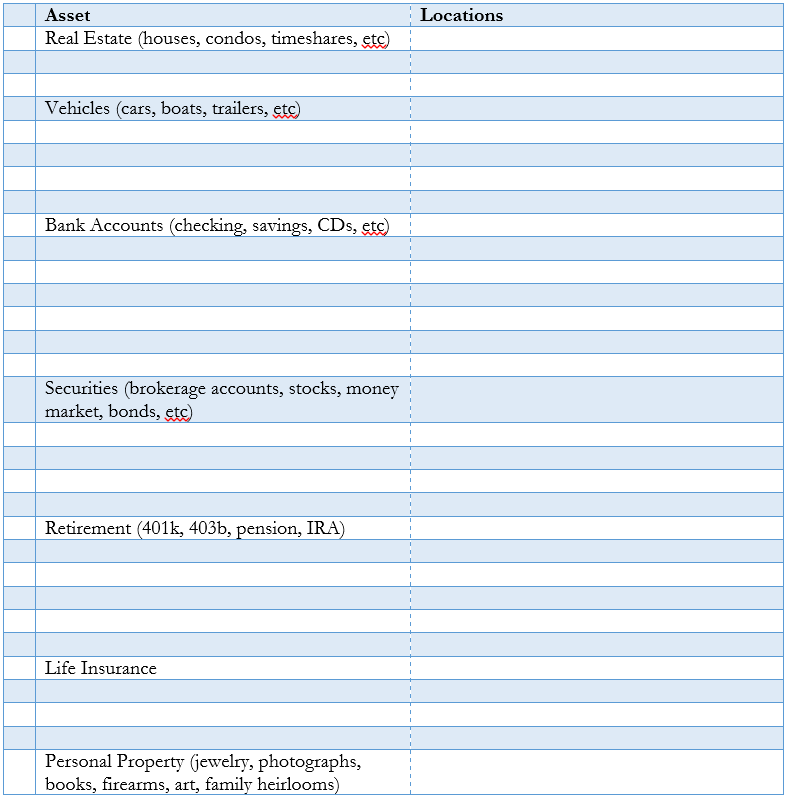
Whether it’s your house or that pillow, you probably want to transfer those important items outside of probate. So to keep in the holiday spirit, I wanted to give you the gift of something practical you can do without an attorney (though I still of course recommend free consultations from the Burkhardt Law Firm to make sure you don’t need more)… The following is a checklist to make sure you have beneficiaries listed or updated and something I would review at least once a year.

Spreadsheet

I included personal property on the list.  However, it’s important to note, a handwritten list alone is not legally enforceable.  So while it does make sense to make a list or at least think about the beneficiaries of personal property, this again is an area to consult an attorney to make sure your wishes will be achieved.

Filed Under: Beneficiaries, Blog Tagged With: Beneficiaries

September 1, 2013 By Martha Burkhardt

Where There’s a Will, There’s a Way… (Sorta)

You know what a will is, right? Right.  Well, at least I’m guessing you do if you’re reading this.  It’s a legal document that says where your assets go when you pass.  But there’s a lot more to it than that. So let’s discuss all a will involves! Fun!

First, I want to address a very common misconception.  Wills go through probate. No discussion, it’s that simple in Missouri.

The next question really is if you need a will then right?  Short answer. Yes.

But of course being a lawyer, the better answer is that it depends.  Do you like Missouri’s intestate laws (where your property goes without a will)?  No, then ABSOLUTELY!   A will (and maybe a pre-nup) is the only effective way to tell the court where you want your assets to go.

Agree with intestate law? Then, you may not need one as much, but you probably still want one for the following reasons.

The most important being your wishes regarding minor children.  Do you have an opinion on whom your children should live with? Make decisions for them? Control their money?  Then you better have a will.  A will is the only document a court will look at for determining guardianship of YOUR kids.  (You can learn more about guardianship here).

A will can also dictate who is in charge of your property throughout the court process.  Don’t want your brother John to handle your assets, but rather your sister Susie? Better get a will and nominate a personal representative.

You’ve heard me say it once, and you’ll hear me say it again. Probate is expensive and time consuming. Having a will can cause the court process to be less expensive and move more quickly.  In a will you can authorize independent administration which allows your personal representative to handle more with your property without court oversight.  You can also allow this personal representative to serve without bond.  This means they don’t have the expense of finding and filing a bond (which can be impossible for those with bad credit).

Using a will in probate can also shorten the time it takes to go through the court by authorizing independent administration.  This allows the personal representative to act without court supervision over many common administrative actions.  In essence, it takes a lot of the burden of court off of the personal representative and might allow things to move more quickly because the personal representative does not need to go to court as often.

So when deciding if you need a will, much of the decision comes down to who your beneficiaries are, how your assets are titled, and how much of a problem a delay in court would cause. Not sure?  Give me a call.

Filed Under: Blog, Children, Probate, Wills Tagged With: assets, Children, Guardianship, Intestate, Personal Representative, prenup, Probate

August 1, 2013 By Martha Burkhardt

Hey, That’s Not What I Wanted?!

Ever been to a restaurant where you ordered something, then when it was brought out, found out that what you ordered wasn’t what you thought it was?  That’s similar to how Missouri intestate law works.

Before explaining what the law says, let me define intestate.  Intestate just means without a will.  So, intestate law is what Missouri says happens to your stuff when you die if you don’t have a will or beneficiaries on assets.

Well that’s fine, but that just means it goes to my spouse who will use it to take care of my kids, right? Nope, and unfortunately, it’s not a simple answer.

Really, it all depends on the structure of your family.  Married? Kids? Kids from a prior relationship?  Here’s a quick chart I came up with to help:

Chart

The people who receive your assets under intestate law are called heirs (instead of devisee, beneficiary, or legatee if under a will or trust).

It’s important to note, that this only provides for biological or legal relationships.  Have a step-child who you consider your own? Not adopted? No heir.  Have a friend who you would like to include?  Too bad.  Have a significant other whom you didn’t marry? Out of luck.

So if this chart shows your assets going to a person or people going where you didn’t expect or don’t want… Well, it might be time to talk about a will.

Filed Under: Beneficiaries, Blog, Children, Wills Tagged With: assets, Beneficiaries, Children, Inheritance, Intestate, Will

July 1, 2013 By Martha Burkhardt

Who Has the Power?

First of all, happy Fourth of July!  In honor of the holidays and those who have made it possible, especially our troops, I want to focus on power of attorneys.  Now I understand the connection between the armed forces and a power of attorney may not be completely obvious, but let me explain.  When out of the country for any reason, most people want to have their estate planning documents for understandable reasons.  But when you’re going overseas unsure of when you’re going to return and without easy communication, it’s a different story.  You need someone with authority over your bank accounts, insurance, maybe even your house.  This is where the power of attorney comes in.

The person making those decisions is called the agent or attorney and fact and the person actually making the document is sometimes referred to as the principal.   Now, power of attorneys come in many different forms and for many different decisions.

There are two types of power of attorneys that are important for most families’ estate plans: a springing power of attorney and a durable power of attorney.  A springing power of attorney only grants the agent the power to act for the person when a certain event occurs.  Hence the springing.  Generally, this occurs when two doctors certify that the person is unable to make decisions for themselves.  This is how I write the majority of the power of attorneys because most families do not need another person able to make decisions over their money and assets.  It also avoids problems when there are conflicting instructions between a person completely capable of making decisions and their agent.  Now, if you are going out of the country and someone needs to be able to access and make decisions for your account, you do NOT want a springing power of attorney.  However, that’s a more detail analysis an attorney can help you make on an individual basis.

The durable power of attorney allows the agent to act for a person if they are incapacitated or if it is unsure whether they are dead or alive.  Because many people execute these forms to plan in case of incapacitation, it’s extremely important to make sure the document has the “magic” language of a durable power of attorney.  As I said before, I generally help my clients with a springing power of attorney.  But I also include the magic durable power of attorney language.

Most people need a financial/legal power of attorney AND a medical power of attorney.  They do not need to be separate documents, but normally are because some people want different friends/family making financial decisions and medical decisions.  Whether it’s one document or two, it’s important they are reviewed to cover most situations, ranging from banking to insurance to health care choices.  A power of attorney may be drafted for almost any specific decision to give another the power to make that decision.  I’ve reviewed documents to allow one sibling to sell a car for the other 6 siblings (much easier than 7 signatures).

What every power of attorney has in common though it’s no longer effective after death.  Therefore the other estate planning documents (wills, trusts, etc) are extremely important.  Also, without a power of attorney designating someone to make decisions, a person must go through the probate court to have someone appointed to make those decisions.  A power of attorney is much easier and cheaper.

On a final note, people ask me when an estate plan is needed, and while many young people do not have enough assets to truly NEED a will, they certainly have the potential for medical issues and absolutely need a power of attorney no matter the age.  Many clients even choose to execute a power of attorney for their minor children’s health care decisions so a grandmother or other trusted caretaker can act in the event of an emergency where the parent is not available.  A great idea if the parents are extremely inaccessible (out of the country, etc).

So if you don’t have a power of attorney or have any questions, give me a call.  Or at a minimum, take the time to execute a free medical power of attorney from the Missouri Bar (found here).

Filed Under: Blog, Estate Plan, Power of Attorney, Trusts, Wills Tagged With: Estate Plan, Health Care Directive, Personal Representative, Power of Attorney, Trust, Will

June 1, 2013 By Martha Burkhardt

Have You Taken Care of Your Children?

Most of my clients contact me because they want to make their children’s lives easier.  Several call after they have lost a parent and dealt with the mess of someone who wasn’t prepared.  Often I hear the sentiment they never want to make their children go through what they’ve had to do.  So, with this in mind, I thought we’d talk about preparing for your kids, specifically minor kids.

There are two distinct areas of planning when you’re talking about your children and estate planning.  And they really apply to everyone with minor children.  First is guardianship.  If something happens to both parents, who will take care of the children?  Most people know maybe have even told someone.  But have they made it legal?  Having a conversation with a desired guardian or other friend is great and definitely recommended, but doesn’t mean your child will go to that person.  A will is the ONLY way to state your wishes for guardianship.  If you do not state your wishes there, the court will make that decision without your input, and most likely choose an older sibling.
So, now that you know how to legally choose a guardian, who should you choose?  There’s a long list of considerations and each person is going to have a different level of importance with each factor, but in my mind the first qualification is trust.  For instance, one of my best friends chose my husband Scott and me to be the guardian for her son.  Now, we’re about 500 miles away from her and her son, so we don’t get to see him that often and if we do end up being his guardian, he’ll be coming to us.  Honestly, not the perfect situation.  However, she doesn’t think her family will raise him with her values in mind.  She trusts us to make those decisions for him.  In addition, she trusts us to say no if it’s not the right decision at the time.

Hopefully, you’re in a position where several of those people come to mind.  No matter your initial thoughts, I would strongly recommend taking the time to fill out a Guardianship Worksheet.  You can find one at the end of this article.

The next consideration is financial.  Even if you don’t have enough to provide for your children for the rest of their lives, you’ll probably be leaving them something.  If you leave more than $10,000 to a minor without a custodian, the court will appoint one.  Again, this takes away your ability to choose who controls your children’s money.  Essentially, this means you don’t want to leave more than $10,000 directly to a minor.  However, if you give that money to another person without legally specifying it is for the benefit of the child, they have no legal obligation to use the money for the child.

If your estate passes through your will, you may add a provision giving a person control of your child’s assets (either called a conservator or a trustee).  However, if you want to avoid probate and plan to use beneficiary designations or other non-probate transfer (pay on death, transfer on death, etc) you cannot just list another person as the beneficiary and expect them to use it for the child.  The easiest way to avoid probate and to designate an adult to control the money is to set up a trust.  This person is called a trustee and must use the money for the child’s benefit.

As you consider choosing a conservator or trustee, keep in mind, this does not need to be the same person as the guardian.  Doing so will make the guardian’s life easier, but if your chosen guardian is not great with money or just needs some oversight, a separate trustee can provide that.  I’ve also seen parents who want to involve both sides of the family and will choose someone from the mother’s side for the guardian and someone from the father’s side for the trustee.  No matter the arrangement, having two different people as guardian and trustee make the
situation more complicated and the two people must be able to communicate well.  This structure should only be used after much consideration.

Finally, unless specified, a minor will be entitled to their money when they turn 18. Will your children be responsible enough to control their money at 18?  If you’re not sure, or doubt it, you can set up a trust (along with a will containing a trust) with specific ages or life stages (i.e. graduating college) when they can access their money.  A trust also allows additional controls on how the money can be used (school, cars, vacations, etc).

As you can probably tell, for most families with minor children, I recommend a will (stating guardianship) and a trust (controlling the assets).  It doesn’t take much, only $10,000, before naming a trustee has its benefits.  But no matter the documents used, whether will or trust, there’s a lot to be considered when planning for your children.  This gives you a place to start, but a lawyer will help you finish the process.

GuardianshipWorksheet

Filed Under: Beneficiaries, Blog, Children, Estate Plan, Trusts, Wills Tagged With: assets, Beneficiaries, Children, Estate Plan, Guardianship, Trustee, Will

May 1, 2013 By clairedejong

Trust Me

On a regular basis I get a phone call from a client wanting to do a will. After sitting down with the client and learning more about their life, asset, and goals they generally decide to do a revocable trust. So, in this mind set and because I’m regularly asked about when a trust is worth it, my top reasons for the average person to do a trust:

1 – PROBATE. Think about your assets. House, car, bank accounts, brokerage accounts, anything without a beneficiary. Total their equity. More than $40,000? You’re going through probate. Probate is a long, expensive, public process, most people want to avoid. A trust can do exactly that. The important issue here is that assets must be in the trust in order to avoid probate.

2 – CONTROL. Now think about your beneficiaries and look at that total you had before. Trust your beneficiaries with that money outright? No? Then a trust can implement controls where your assets are only used in ways you specify or at time when you think your beneficiaries will be responsible with those assets. This directly applies to minors and children. At times, the court will appoint a person to control a minor’s assets. This means they will most likely gain access to those assets when they reach the age of 18. Will the beneficiary really be conscientious enough at 18 years old to use those assets in their best interest? In addition, will the court appoint the same person you would choose to handle your money?

3 – COMPLICATED FAMILIES. This is a bit unfair, as I admit, we all have complicated families. However, I really mean families with step-children and step-parents or families where disinheritance is a reality. General beneficiary schemes do not account for these “non-traditional” families and it’s often important to use a trust to guarantee the people you wish have access and control over assets.

4 – MULTIPLE BENFICIARIES. If your assets are over that $40,000 mark and you still want to avoid probate, it is possible to list beneficiaries on most assets. However, when you have 6 beneficiaries (especially when a few of them are married) it makes it complicated when they try and sell an asset. In most cases, all of their signatures (and perhaps their spouses) will be required for a sale. Beyond the problems and delay actually gathering all of the signatures, it also can create problems when one person disagrees on what to do with the house or a car. In a trust, they all can benefit from assets, but only one (or maybe two) people make the decision and sign off on that decision.

5 – CONTINGENCIES. In the same aspect, if you are worried about probate, beneficiaries on most forms are limited. There are only spaces for limited beneficiaries and in addition to the number of contingencies, they limit how complicated the beneficiary scheme can be. For example, you have two beneficiaries. Something happens to the one and you’d like their share to go to their children instead of to the other beneficiary. Most beneficiary forms do not allow for this level of detail. It either all goes to one level or the other. A trust can consider your beneficiaries and family as a whole.

6 – PROBATE. So, you’ve seen this once, but it deserves another mention. As you’ve probably gathered at this point, there are other ways to avoid probate. With a small and “traditional” family without minors or other needs for control, those other forms work great. However, in reality those situations rarely exist. That is why after I sit down with most clients they no longer want just a simple will; they want a trust.

Filed Under: Beneficiaries, Blog, Probate, Trusts, Wills Tagged With: assets, Beneficiaries, Children, Estate Plan, Probate, Trust, Will

April 1, 2013 By clairedejong

How Much Do You Know

When I sit down with clients, there’s a varying level of knowledge about estate planning, the different documents, and just what everything means. As such, my job is often to make sure people know how the law works and what happens in different situations so my clients can make the best decisions themselves with advice from me where they want it. So, for this month, I thought I’d start with the basics:

  • pic_06What is probate?
  • What is a will?
  • What is a trust?
  • What is a power of attorney?
  • What is an advance health care directive?

Probate is the court process a person’s property goes through when they die to transfer the property out of the deceased’s name. Wills must go through probate (though it took Esq. behind my name for my mother to believe me on that). You can avoid through non-probate transfers, such as transfer-on-death (“TOD”s), payable-on-death (“POD”s), trusts, joint titling, and other methods. Probate is time consuming and can be very expensive. Because of this many people specifically form an estate plan to avoid probate. If you’re worried about your beneficiaries being unable to access quickly or wasting resources on court, talk to an attorney. There are many methods to avoid probate and not all are appropriate for everyone.

Trusts, however, are the main way to avoid probate. A properly funded trust effectively re-titles property from a person’s name to the trust. The person then decides who benefits from the trust assets and who controls those assets until they pass or are no longer competent to make decisions. Generally, the person setting up the trust may benefit and control the assets. This allows a person who becomes incapacitated to continue to benefit from their property, but gives a different, competent person the ability to make decisions regarding that property.

It’s very important to note the “properly funded” part. If property is not actually transferred to a trust (normally by renaming the asset in the name of the trust), then the property cannot be transferred through the trust documents and must still go through probate and a will or state inheritance law.

So, every estate plan (whether a trust is involved or not) should include a will. Wills set out a person’s wishes upon their death for guardianship of minor children and any property not transferred through non-probate transfers. This means that anything with a beneficiary (i.e. life insurance, retirement plans), TOD, POD, jointly titled, etc. are not given away according to the will.

Along the same lines, every estate plan needs a Power of Attorney. Powers of Attorneys come in many different types, but generally should cover legal, financial, and medical decisions. The document gives another person the power to make decisions for the person. The types of decisions can be limited and the document can be drafted so it only goes into effect when a person becomes incompetent.

Finally, a Health Care Directive establishes a person’s desires regarding specific medical situations. It covers circumstances where a person is unable to make decisions regarding their wishes, but can be used outside of terminal conditions (unlike a Living Will).

A full estate plan covers all of these areas and uses each document to make sure you are completely protected. Hopefully, this has explained the basics for you, but please if you have any questions email me or contact me here.

Filed Under: Blog, Joint Titling, Power of Attorney, Probate, Trusts, Wills Tagged With: Beneficiaries, Estate Plan, Health Care Directive, Inheritance, Joint Titling, Living Will, Power of Attorney, Probate, Trust, Will

  • « Previous Page
  • 1
  • …
  • 6
  • 7
  • 8
  • 9
  • Next Page »

Categories

  • Blog
    • Estate Plan
      • Beneficiaries
      • Children
      • Gifting
      • Joint Titling
      • Power of Attorney
      • Trusts
      • Wills
    • Probate
    • Traffic
  • Final Arrangements

Archives

Free Consultation Request

Free Consultation Request

Do you have a question that only a lawyer can answer? Request a free consultation now.

Burkhardt Law Firm

Phone: (314) 518-1581
Email: mburkhardt@burkhardtlaw.com
Address:
2333 Grissom Dr., Suite 107
St. Louis, MO 63146

About Us

  • About Burkhardt Law
  • Who is Martha Burkhardt?
  • Our Mission
  • Client Testimonials
  • What is Different About Burkhardt Law?
  • Contact Us
  • Free Consultation Request
  • Blog

Estate

  • Securing Your Family’s Future
  • Why Estate Planning?
  • Is it Time for a Will?
  • The Impact of a Health Care Directive
  • What is a Trust?
  • Power of Attorney
  • Deeds
  • Estate Planning Consultations

Business

  • Building a Firm Business Foundation
  • Contract Review
  • Operating Agreements
  • Company Formation

Traffic Law Assistance

  • Traffic Law Assistance
  • Why Get a Lawyer for a Traffic Ticket?
  • Traffic Help Now

The choice of a lawyer is an important decision and should not be based solely upon advertisements. Any information on this page should not be taken for legal advice. Use of this website does not create an attorney/client relationship.

Copyright © 2026 · All content owned by Burkhardt Law. Website created and managed by Worry Free Marketing, St. Louis. Sitemap.